
In 2023, HRiA conducted a landscape scan for PHCC, a national initiative focused on improving public health communication. The scan identified significant gaps in health communication learning opportunities, including a lack of interactive trainings tailored to public health officials and insufficient focus on critical topics such as community trust-building and equity. Such gaps reduce the ability to respond effectively and impactfully in high-stakes situations. These gaps underscore a growing need for useful, high-quality training.
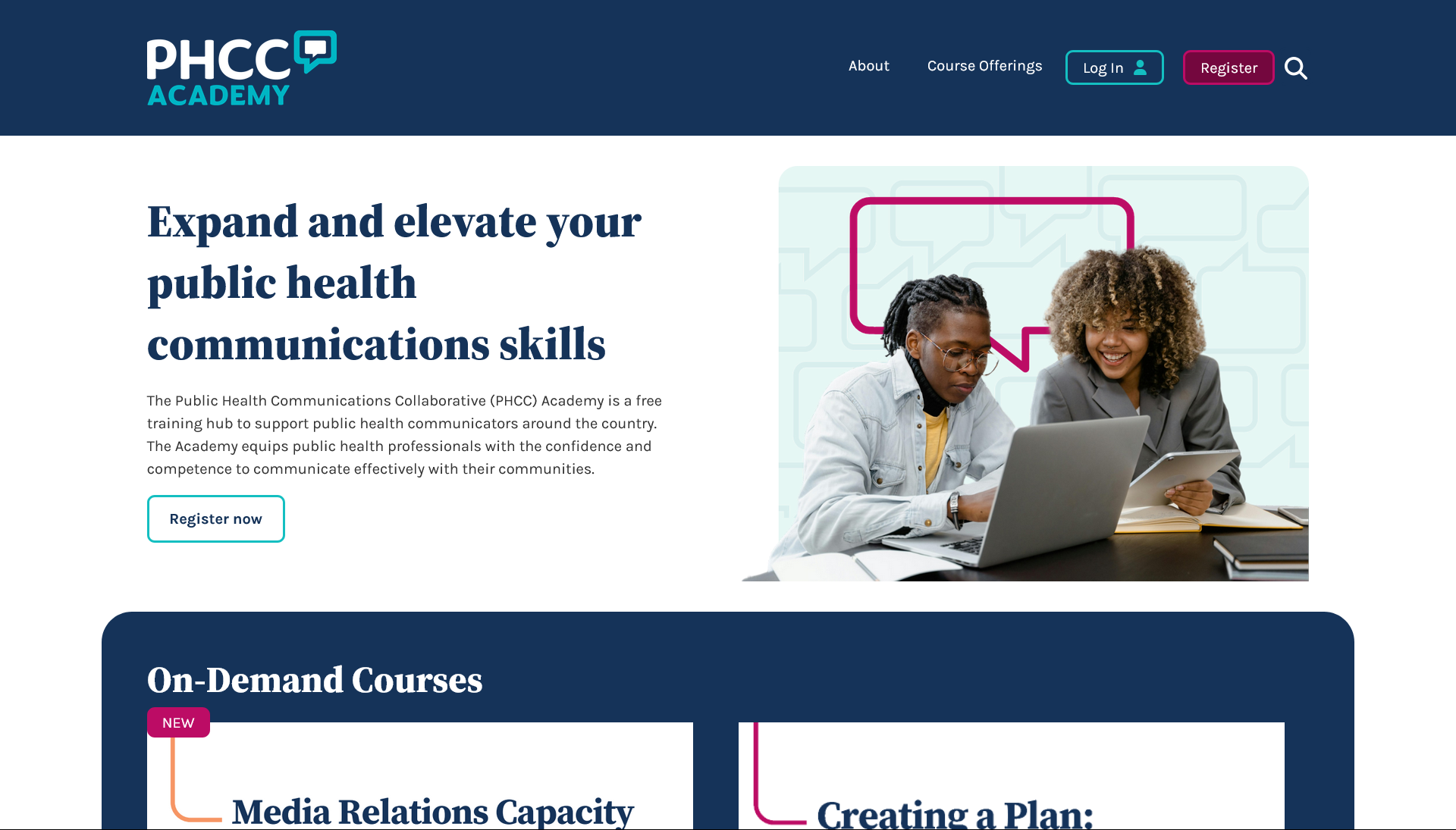
In response, PHCC engaged HRiA to translate key insights into goals, guiding principles, priority competencies, and an approach to evaluation and continuous improvement. The PHCC Academy, an online communications learning hub, emerged from this work. The Academy provides a range of strategies, resources, and tools that strengthen communication capacity of public health professionals nationwide.
Approach
To bring this vision of the Academy to life, HRiA focused on two priorities: developing a scalable online training solution and producing engaging content that meets the needs of public health leaders. This approach combines subject matter expertise, instructional design, and digital production.
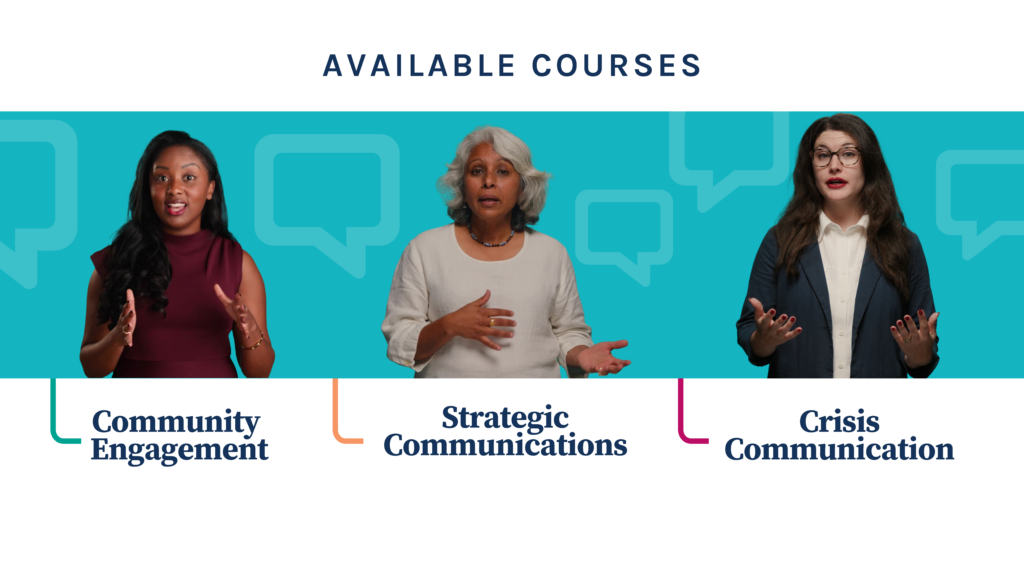
An experienced team from HRiA spanning training and health communication practice areas collaborated with partners on topic selection, recruiting instructors with relevant field experience, and shaping course materials to ensure value. PHCC and HRiA issued public calls to identify subject matter experts across professional channels, including LinkedIn and sector-specific listservs. Candidates were selected based on a combination of demonstrated expertise, relevant experience, and their ability to communicate ideas to diverse audiences. HRiA coached instructors on script development and delivery to facilitate clear, confident presentations in an on-demand format. The team and instructors collaboratively created content that is accurate, accessible, and informed by real-world practice. To help participants apply key concepts, they also curated resources and supporting tools.
Instructional design principles—including defining clear learning objectives, incorporating knowledge checks, and using participant feedback to inform ongoing refinement—guided training development. Adult learning theory and varied engagement strategies were integrated throughout, creating multiple ways for participants to engage with and absorb material. Building on this foundation, courses were structured across both on-demand (asynchronous) and live cohort (synchronous) formats, allowing participants to engage with core concepts independently while deepening their understanding through discussion, reflection, and real-time application. These design and delivery choices create a participant-centered learning experience tailored to the needs of the public health workforce.
Collaboration with a skilled digital production team, including video production and website development, enabled the implementation of the Academy. The team partnered with videographers to achieve high-quality video content and with user experience specialists to design an intuitive platform. HRiA’s technology team developed, implemented, and continues to maintain the learning management system, keeping the Academy reliable, user-friendly, and ready to scale.
HRiA has been an invaluable partner in developing the PHCC Academy’s training offerings. Their team brings a rare combination of instructional design expertise, public health experience, and technical execution that helps turn complex communication topics into practical, engaging courses. The result is training that meets public health communicators where they are and gives them tools they can apply directly in their work.
Bethany Kuerten, MSc
Senior Program Associate, PHCC
Why It Works
Within its first week, 1,750 users registered. The Academy now has over 6,000 users, with 1,600+ users completing at least one course. These metrics demonstrate robust engagement and the Academy’s ability to provide accessible, high-caliber training.
The Academy’s success is rooted in its flexible, free-access model, which promotes broad participation across the U.S. On-demand courses accommodate busy schedules, while live offerings deliver timely, interactive learning experiences. Backed by PHCC resources and national partners, the platform combines foundational knowledge with timely topics, helping public health communicators strengthen their skills and respond to evolving challenges.
The quality and relevance of the Academy’s content further drive its effectiveness. HRiA partners with credible subject matter experts and applies instructional design best practices to ensure courses cover current public health challenges and draw from trustworthy sources. Professional production, along with complementary tools and resources, supports application in day-to-day work.
From an instructor perspective, the combination of asynchronous and synchronous learning was incredibly effective. The async content created flexibility and a strong foundation for learning, while the live sessions brought the material to life through discussion and practical application. The sync sessions were especially valuable because they fostered meaningful connections among public health peers across the country and created space for collaborative troubleshooting and shared learning grounded in real-world practice.
Dr. Jeni Stolow
Tulane University
Deep Dive: Designing for a Rapidly Developing Topic
The development of an AI course presented the HRiA team with a distinct challenge. Unlike topics such as crisis communication and media relations, which are grounded in established principles, generative AI is transforming quickly, requiring the team to develop content without a fixed set of norms. In response, the team is launching “AI with Intention: Tools and Judgment for Public Health Communicators,” a course designed to help communicators evaluate how and when to use AI in their work while maintaining accuracy, trust, and professional standards.

Public health communicators are already making decisions about AI whether they feel ready or not. This course meets them where they are and gives them a framework for navigating those decisions in ways that hold up, even as the technology keeps shifting.
Erika Gaitán
Director of Impact and Innovation, HRiA
Looking Ahead
The PHCC Academy will expand its programming with an additional course planned for release in late January 2027.
As challenges such as misinformation and new technologies shift the communications landscape, the Academy will provide practical learning opportunities to support public health professionals as they navigate an increasingly complex information environment.
To ensure its offerings remain relevant and responsive, PHCC will also continue to gather input from Academy users to guide future priorities. Public health officials are encouraged to share ideas through an open survey, ensuring the Academy remains relevant and grounded in real-world practice.
QUICK LINKS